Dog Body Language Decoded: 10 Subtle Behaviors That Show What Your Dog Really Feels
Learn 10 dog body language signals—from play bows to sighs—that reveal trust, excitement, and how safe your dog feels with you.
Most people think dog body language is easy: tail wag equals happy, growl equals mad. But your dog is running a whole second conversation under the obvious stuff—one that shows trust, stress, excitement, and attachment in surprisingly specific ways.
Below are 10 behaviors you’ve probably seen a hundred times, plus what they tend to mean in real life.
1) The play bow: “I’m choosing you”
That classic pose—front legs down, butt up—often gets labeled as a cute stretch. In reality, it’s one of the clearest “this is friendly” signals dogs use, especially during play.
What makes it special is how intentional it is. Dogs use the play bow like punctuation: it can restart play after a pause, smooth over a moment that got too intense, or clearly say, “Whatever happens next is still play.”
If your adult dog does it to you, it’s not just an invitation—it’s a trust statement. They’re putting themselves in a vulnerable position and saying, “I feel safe with you.”
2) The bathroom shadow: secure base behavior
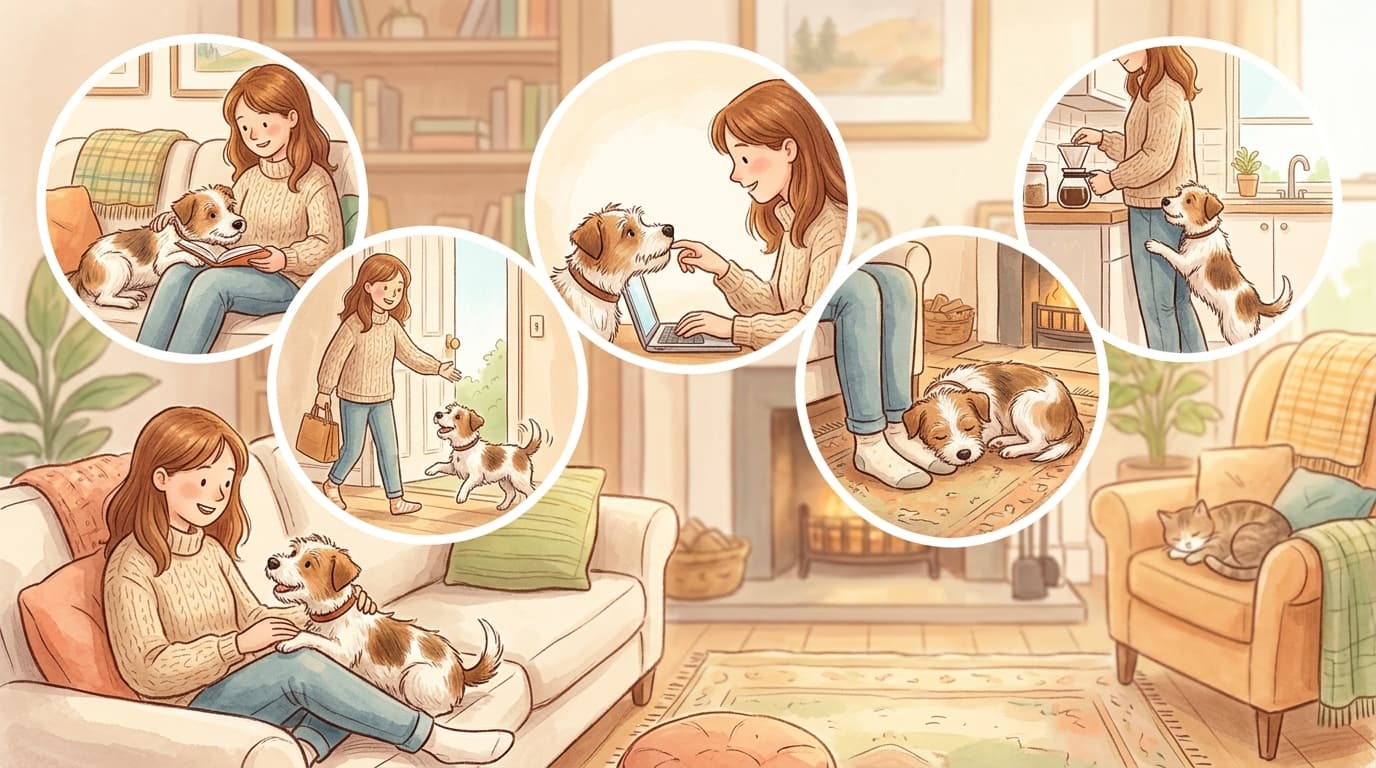
If you’ve ever noticed your dog following you down the hall and then waiting outside the bathroom door like it’s their job, you’re not alone. This isn’t automatically “clingy” behavior. It’s often attachment in action.
Researchers describe dogs using their people as a “secure base,” similar to how kids use parents: your presence helps their nervous system settle. When you disappear behind a door, their brain doesn’t think, “She’ll be back in three minutes.” It thinks, “My safe person moved—track them.”
Some dogs wait quietly. Others pace or whine softly. Either way, it’s usually more about safety than drama.
3) The head tilt: your dog’s brain working in real time
Head tilts are one of those moments that make you feel like your dog is truly listening—because they are. Studies suggest head tilting can be linked to processing familiar words and concentrating on meaning.
If you say something your dog knows (“ball,” “walk,” “toy”), and you get a tilt, it may be your dog searching memory, building a mental picture, and checking your tone for clues. If you’ve ever watched your dog tilt and then sprint to the right room like they suddenly remembered where the good stuff lives… that’s the magic.