Your dog isn’t being “weird” just to be weird. A lot of those everyday habits—following you into the bathroom, leaning on your leg, licking your face, sniffing people a little too personally—are actually part of a communication system that’s been shaped by thousands of years of living alongside humans.
Most pet owners don’t realize there’s research behind these moments. But once you know what your dog is doing, the same behaviors stop feeling random and start feeling like a relationship.
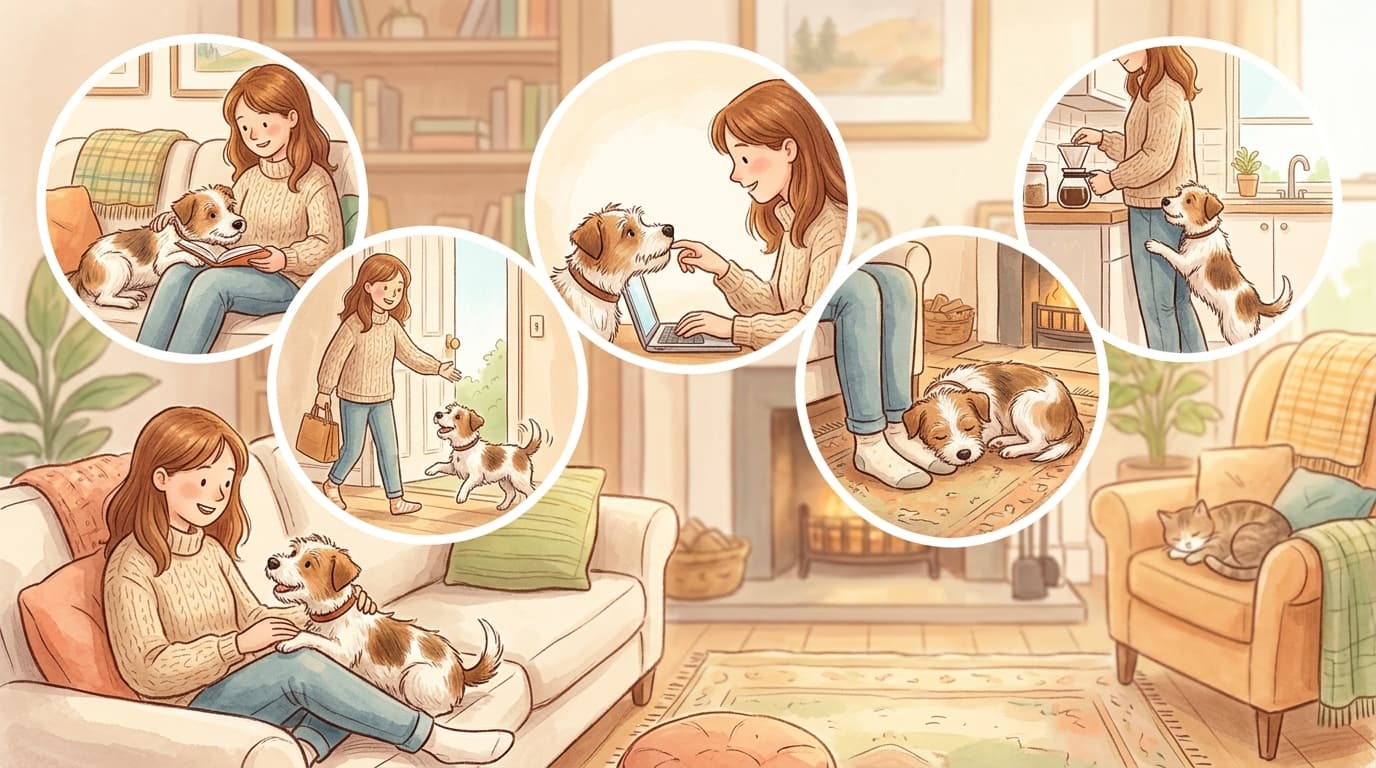
If you’ve ever noticed your dog pop up the second you stand up—then trail you down the hall like a fuzzy little bodyguard—it’s not just curiosity.
Researchers have tested dog-human bonds using a classic attachment experiment originally designed for human infants (often called the “strange situation” setup). The takeaway is simple: dogs tend to treat their person as a secure base. When you’re nearby, they feel safe enough to explore. When you leave, stress goes up. When you return, they check in with you to make sure their world makes sense again.
That’s why the bathroom thing happens so often. Your dog doesn’t necessarily need to be in the bathroom. They need to keep track of where you are.
That quick face lick the moment you sit down can feel like your dog saying, “Hi, I love you.” And… they kind of are. But there’s more going on than manners (or lack of them).
Studies on dog-human interaction have found that certain behaviors—especially mutual gazing—can raise oxytocin levels in both dogs and people. Oxytocin is the hormone we associate with bonding and connection. In other words, some of the ways your dog interacts with your face can be part of a feedback loop that helps both of you feel attached.
And here’s the wild part: similar experiments with human-raised wolves don’t show the same effect. Dogs, through domestication, seem uniquely tuned to this two-way bonding pattern with humans.
You know that move where your dog quietly presses their full weight against your leg and just… stays there? It’s easy to assume they want something. Sometimes they do. But often, it’s more like your dog is starting a calming contact moment.
Touch matters. Physical contact can trigger measurable chemical changes tied to relaxation and bonding. For many dogs, leaning is a simple way to connect without demanding attention—almost like saying, “I’m with you,” without needing anything else.
Some dogs hear a loud noise, spot a stranger, or get overwhelmed—and instead of barking or hiding, they trot off and come back with a toy or a shoe.
It looks goofy. But it can be a real emotional regulation tool.
Behavior scientists call this displacement behavior: when arousal spikes and the dog’s brain needs an outlet, it redirects energy into an action that’s safe and familiar—like grabbing an object. It gives their mind a “task,” which can take the edge off the stress.
So if your dog does this, you’re not necessarily seeing silliness. You might be watching your dog self-soothe in real time.
A dog sigh can melt your heart—or make you think they’re being dramatic. The trick is to look at the whole picture, not just listen.
A relaxed sigh paired with soft, heavy-lidded eyes usually signals contentment: your dog is settled and comfortable.
But a sigh with wide, alert eyes—especially if they’re staring toward something they want (a door, a treat cabinet, you putting shoes on)—can read more like mild frustration or disappointment. Same sound, totally different message. The “decoder” is their face.
If your dog howls at emergency sirens, it’s tempting to assume they’re scared or in pain from the noise.
Another possibility: the sound pattern of sirens can resemble the acoustic shape of distant canine calls enough to light up old instincts. In wolf-like social systems, howling helps locate group members over distance—basically, “I’m here, where are you?”
So your dog may be responding as if they heard another dog calling out, and they’re answering. Then the siren ends, nobody “responds,” and your dog moves on.
Yes, it’s awkward. Yes, you’ve probably tried to steer your dog away with a panicked laugh.
But from your dog’s point of view, this is one of the fastest ways to learn who someone is.
Dogs have an extraordinary sense of smell, and they also have a special chemical-detection system (the vomeronasal organ) that helps them pick up pheromone-like signals. Areas of the human body with lots of scent-producing glands provide a concentrated “profile,” so your dog can quickly collect details about identity, emotional state, and other biological clues.
Think of it like reading a biography—except it takes seconds, and it’s written in scent.
Sniffing on walks isn’t your dog being stubborn or “distracted.” It’s mental work.
Research on scent-based activities (often called nose work) suggests that giving dogs opportunities to sniff can improve their emotional state and reduce stress signals. For your dog, sniffing is focused engagement—like a deep, satisfying mental exhale.
So the next time your dog slows down to investigate a patch of grass, consider that they might be doing something genuinely good for their nervous system.
This one makes people laugh, but it’s surprisingly meaningful.
When dogs go to the bathroom, they’re in a vulnerable position. If your dog looks up and holds eye contact with you, it can be a trust check—your dog confirming you’re there, watching the environment, and that it’s safe to finish.
A simple way to respond is to stay present and calm. You don’t have to make it a big moment. Just be their backup.
None of these behaviors are random. They’re signals—about safety, connection, stress relief, curiosity, and trust. Once you start reading them that way, you’ll notice your dog isn’t just doing cute things… they’re building a steady relationship with you in dozens of small moments.
Pay attention to the little check-ins today. Your dog has been communicating all along—you just got a better dictionary.