Why Your Dog Picked You: The Science Behind That “Meant to Be” Feeling
From puppy-dog eyes to the oxytocin gaze loop, science explains why your dog’s bond with you can feel like fate.
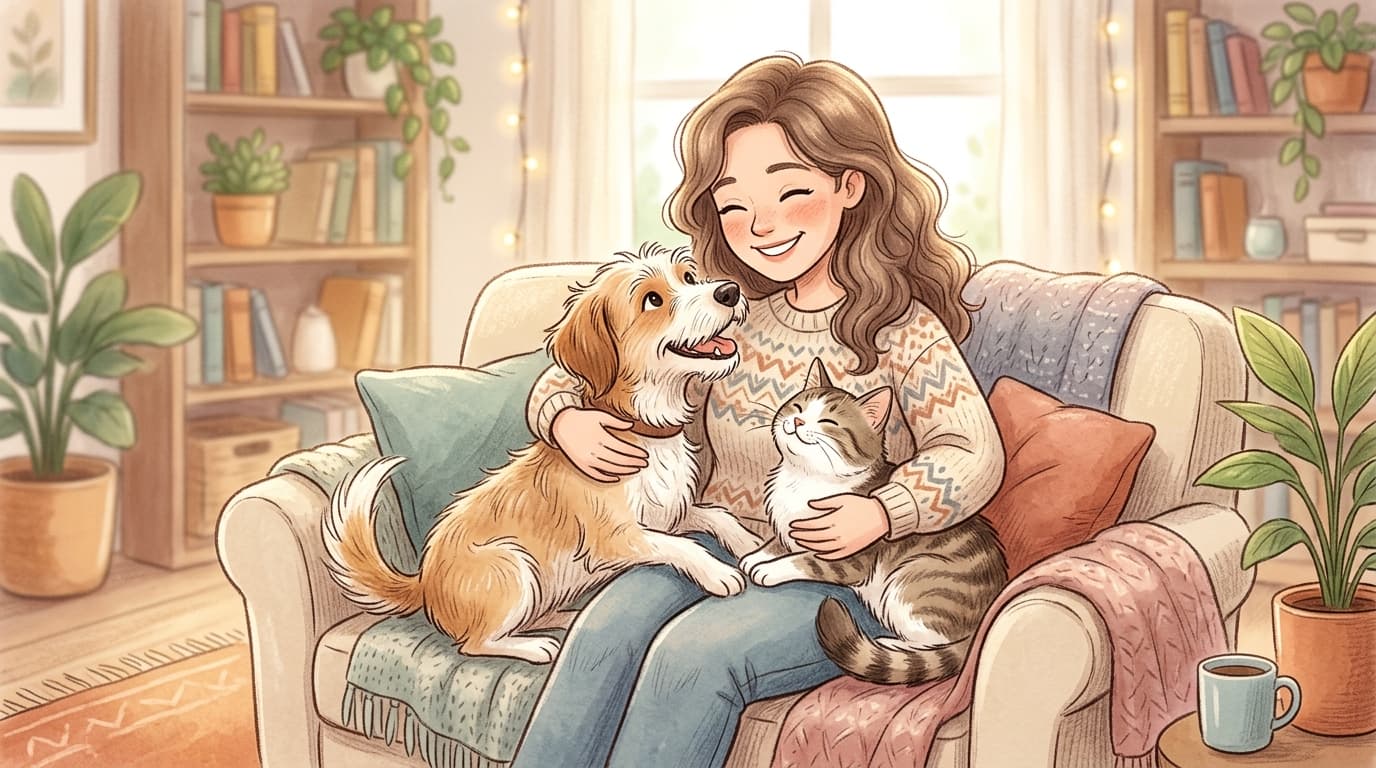
Most people remember meeting their dog like a lucky accident—one shelter visit, one “just looking” moment, one friend’s litter that happened to be available. But the bond you feel isn’t random in the way we usually mean it. A lot of what makes your dog feel like your dog was shaped by thousands of years of dogs and humans evolving side by side.
The human–dog bond didn’t happen overnight
Dogs and humans have been partners for roughly 15,000 years. That’s long enough for something bigger than “a tame wolf” story to form—more like two species slowly adjusting to each other until the partnership became almost inevitable.
What researchers have learned in recent decades is that dogs didn’t merely lose wild traits. They gained new, human-focused abilities—skills that make them unusually good at living with us, understanding us, and bonding deeply.
Dogs are built to read your social cues (and wolves usually aren’t)
One of the clearest examples is pointing. For you, pointing feels simple: you gesture toward a toy, a treat, the door, and your dog often understands.
What’s fascinating is that even wolves raised closely by humans don’t reliably interpret pointing the way dogs do. It’s not about being “smarter.” It’s about being wired for human communication. Dogs, as a species, developed a special talent for tracking our signals—our gestures, our attention, and the meaning behind them.
If you’ve ever had your dog trot directly to what you indicated like it was the most obvious thing in the world, you’ve seen that evolutionary teamwork in action.
“Puppy dog eyes” are more than a cute expression
There’s also a physical detail that feels almost unfair once you hear it: dogs developed facial muscles that are far less developed in wolves. One of these muscles helps create that classic inner-brow raise—the look that makes your heart do something soft and immediate.
That expression isn’t just an accident of cuteness. It taps into the human nurturing response. In plain terms: dogs evolved faces that humans emotionally respond to, and that helped the dog–human partnership thrive.
Your dog can recognize distress—even in strangers
You’ve probably felt it: you come home carrying a rough day, and your dog seems to know before you say a word.
Research has shown that dogs tend to approach people who are crying more than people who are humming or speaking normally. Even more striking, dogs often respond to a crying stranger similarly to how they respond to their own person.
That suggests your dog isn’t only reacting to “their favorite human acting weird.” They’re processing emotional information itself.
How do they do it? Dogs pull from multiple channels at once:
- Voice tone (the sound of stress)
- Facial expression
- Posture and movement
- Scent cues tied to stress chemistry
Most pet owners don’t realize how much data a dog gathers in a few seconds. When your dog leans into you on a hard day, it may feel like magic—but it’s also a very real, very specialized kind of perception.
Loyalty has chemistry behind it
Stories of extreme loyalty hit differently when you understand there’s biology under the devotion. One famous example is Hachiko, the Akita who waited at a train station day after day for his owner who never returned.
That kind of loyalty isn’t just “good manners.” Bonding chemistry plays a role—especially systems connected to attachment and anticipation. In dogs, the brain can reinforce the expectation of reunion. Waiting, watching, listening—these behaviors can be sustained by the same reward circuitry that motivates them in the first place.
That’s why your dog’s routine when you leave—window watching, door listening, pacing—can be so intense. Their brain is built for reunion.
The oxytocin gaze loop: why eye contact feels so powerful
Here’s one of the most mind-blowing findings in dog science: calm, natural eye contact between you and your dog can raise oxytocin (the bonding hormone) in both of you.
In a well-known study, mutual gazing boosted oxytocin in humans dramatically—and in dogs even more. When researchers tried a similar setup with human-socialized wolves, the same bonding loop didn’t show up in the same way.
That suggests something big: dogs didn’t just learn to tolerate our faces. They evolved a bonding system that locks in through connection, especially through the eyes.
So when your dog looks at you from across the room and you feel your mood soften, that’s not you being silly. That’s your body responding to attachment cues it understands at a deep level.
Your dog’s nose may know things before you do
A dog’s sense of smell is in a completely different league from ours—hundreds of millions of scent receptors, plus a brain built to interpret scent with incredible detail.
Researchers have documented trained dogs detecting certain diseases from samples with impressively high accuracy in controlled settings. There’s also research interest in dogs that appear to anticipate events like seizures before humans notice obvious signs.
Your dog isn’t a medical device, of course. But it’s worth appreciating that “clingy” behavior—following you, hovering, pressing close—may sometimes be your dog gathering information and responding to subtle changes you can’t detect.
Dogs quietly build your social life, too
One of the most practical “why you” reasons is simple: dogs pull humans into contact.
Large surveys across multiple cities have found dog owners are far more likely to meet neighbors and form local connections than non-dog owners. A dog turns a sidewalk into a conversation starter. They approach with friendliness, and you end up talking to someone you’d otherwise pass like a stranger.
Your dog doesn’t care about the invisible social walls adults build. They just… break them.
Your dog lives in the present—and it rubs off on you
Your dog doesn’t rehearse next week’s worries while eating dinner. They don’t replay awkward conversations at 3 a.m. They re-enter the present moment again and again through smell, sound, and attention.
Humans are incredible at planning and storytelling—but that constant narrative can also be exhausting. Dogs model something different: full presence without effort. If you’ve ever watched your dog investigate a patch of grass like it contains the meaning of life, you’ve seen that “now” mindset in its purest form.
A simple 3-minute bonding practice you can try tonight
If you want to feel the bond in your body (not just understand it in your head), try this once when your home is quiet:
- Sit close and let your dog settle (no commands, no agenda).
- Gently meet their gaze for one minute—soft eyes, not intense staring.
- Rest your hand on their chest for two minutes, feeling their heartbeat and breathing.
It’s simple, almost awkward the first time, and surprisingly moving. You’re giving your nervous system and your dog’s nervous system a chance to do what they’re designed to do together: sync.
The takeaway
Your dog didn’t choose you because you’re perfect. They chose you because dogs are built—through evolution, bonding chemistry, and social intelligence—to attach deeply to a person and make a life around that connection.
So the next time your dog looks up at you like you’re their whole world, let it land for a second. That relationship is older than either of you, and you get to live inside it every day.
Continue reading

Why Your Cat Walks on You at Night (And What They’re Really Trying to Tell You)
If your cat steps on your chest at night, it’s not random. Here are the real reasons—and how to respond without encouraging 5 a.m. wakeups.

Why Your Cat Headbutts You: The Sweet Meaning Behind Feline “Head Bunting”
Cat headbutting (head bunting) is a sign of trust and affection. Learn what it means and how to respond the right way.

Male Dogs vs Female Dogs: 5 Real Differences You’ll Notice at Home and on Walks
From pee-mail to leash pulling and rough play, here are 5 everyday ways male dogs tend to differ from females.